
Scopus article
Authors: Assia Ouzani,Hamida Maachou,Nabil Touzout,Hamza Moussa,Yamina Zouambia,Mahfoud Ainas,Adil Mihoub,Domenico Prisa,Jakub Černý,Yaser Hassan Dewir &Aftab Jamal
Abstract
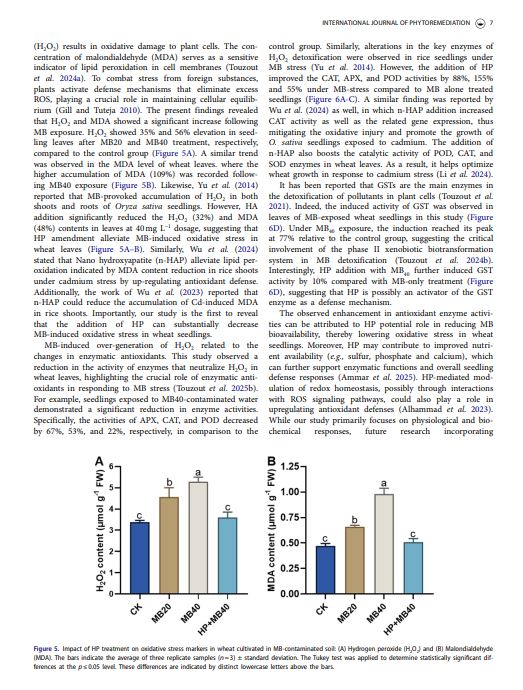
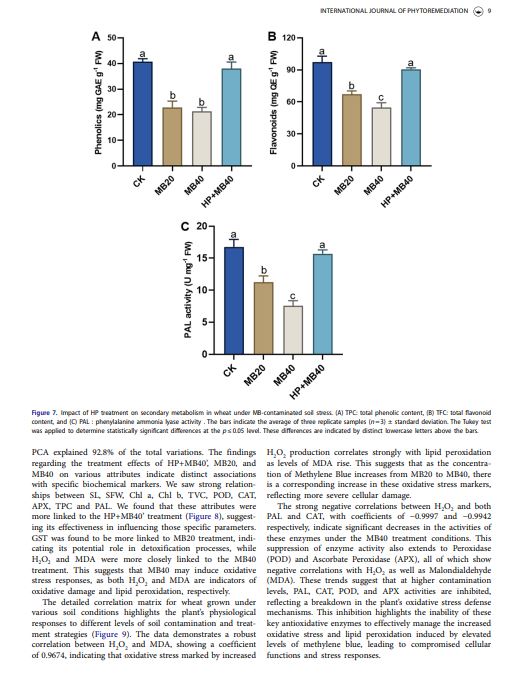
Methylene blue (MB) contamination in agricultural systems, primarily from industrial wastewater, disrupts plant physiology by interfering with photosynthesis, inhibiting root nutrient uptake, and altering microbial dynamics. This leads to oxidative stress, nutrient imbalances, and stunted growth, reducing crop yields. Hydroxyapatite (HP) has been previously explored for its role in soil remediation and nutrient management, but its potential in alleviating dye-induced oxidative stress in crop plants has not been reported until now. This study is the first to demonstrate that HP can be repurposed as a dual-function biocompatible amendment to both adsorb MB and mitigate its phytotoxic effects in wheat (Triticum aestivum L.) seedlings. Wheat seedlings were hydroponically exposed to MB (20 mg L−1 and 40 mg L−1), and key physiological and biochemical parameters were assessed. MB stress significantly reduced chlorophyll a (54%), chlorophyll b (52%), and carotenoids (40%), while increasing hydrogen peroxide (H2O2) by 35%–56% and malondialdehyde (MDA) by 109% at MB40 treatment. HP (1 mg L−1) application improved dry weight (89%) and seedling length (68%), enhanced chlorophyll a (108%), chlorophyll b (84%), and carotenoids (65%), while reducing H2O2 (32%) and MDA (48%). Additionally, HP enhanced antioxidant enzyme activities, including ascorbate peroxidase (155%), catalase (88%), and peroxidase (55%) under MB stress. HP alleviated growth inhibition and oxidative stress by causing enhancement of the activity of the enzymes and related metabolites of the xenobiotic detoxification system and the secondary metabolism pathway. These findings suggest that HP effectively alleviates MB-induced oxidative stress, improving photosynthetic pigments and antioxidant defense mechanisms. This research supports HP as a sustainable amendment to enhance crop resilience in contaminated agricultural systems.
NOVELTY STATEMENT
This study uniquely demonstrates hydroxyapatite’s (HP) effectiveness in mitigating methylene blue (MB)-induced stress in wheat by enhancing photosynthesis and antioxidant defense. It extends HP’s role beyond conventional applications, providing a sustainable strategy to improve crop resilience in contaminated environments.
Keywords:
Link: https://doi.org/10.1080/15226514.2025.2544773







 TECNICHE INNOVATIVE PER LA COLTIVAZIONE E DIFESA DELLE PIANTE, L'APICOLTURA, LA ZOOTECNIA E IL RISANAMENTO AMBIENTALE