
Scopus scientific article
Multidisciplinary Science Journal
Research Article | Vol. 8 Issue 4 (2026), e2026256 | Published in 24 September 2025
Authors: Domenico Prisa and Aftab Jamal
https://10.31893/multiscience.2026256
Abstract
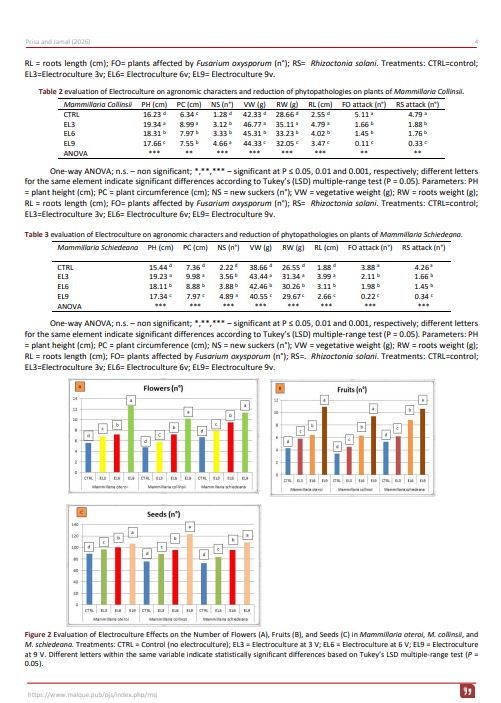
This study investigated the effects of electroculture on vegetative and root development, reproductive performance (flower and fruit production), and resistance to phytopathogens in three Mammillaria species: Mammillaria oteroi, Mammillaria collinsii, and Mammillaria schiedeana. For each species, 30 rooted cuttings were assigned to each treatment group, with three replicates of 10 plants each. Cultivation began in early August 2024, and all plants received a slow-release fertilizer incorporated into the substrate at the time of transplanting. To ensure standardized growing conditions, electric currents of 3V, 6V, and 9V were applied to the experimental pots for one hour daily. A control group of 30 plants per species received no electrical treatment. A range of agronomic and phytopathological parameters were subsequently assessed. Among all species, the 3V treatment produced the most favorable results for plant height, stem girth, vegetative, and root biomass, and root hair length. In contrast, the 9V treatment significantly enhanced the number of offshoots, flowers fruits, seed yield, and resistance to fungal pathogens. On average, the 3V treatment led to a 44.0% increase in stem circumference, a 31.3% increase in plant height, a 26% improvement in vegetative growth, and a 23% increase in root development compared to untreated controls. The 9V treatment increased flower number by 54%, fruit number by 63.2%, and seed production by 34.9% relative to controls. Additionally, plant mortality due to Fusarium oxysporum and Rhizoctonia solani was reduced by 80% and 90%, respectively, under the 9V treatment across all species. These findings demonstrate that electroculture can significantly enhance growth, reproductive output, and pathogen resistance in Mammillaria spp. Further studies across a broader range of plant taxa are warranted to confirm and generalize these results.
Keywords: electricity sustainable applications microorganisms magnetism plant stimulation
References
Aguilara, J. O., Riverob, D. S., Puentesa, A. E., Perillaa, P. E. V., & Navarro, A. M. S. (2015). Comparison of the effects in the germination and growth of corn seeds (Zea mays L.) by exposure to magnetic, electrical and electromagnetic fields. Chemical Engineering Transactions, 43, 169–174 https://doi.org/10.3303/CET1543029
Ahmad, E. (2003). Effect of magnetic field on yield and growth in strawberry Camarosa. The Journal of Horticultural Science and Biotechnology, 78(1), 145–147.http://dx.doi.org/10.1080/14620316.2003.11511597
Aquita, M. D. C., Fadera, B. B. E., Biado, M. A. V., Gonzales, C. F. B., Uminga, A. G., & Virtucio, R. S. (2023). Effectiveness of utilizing induced magnetism on the seed germination of radish (Raphanus sativus). Guild of Educators in TESOL International, 1(2), 106–118.https://doi.org/10.5281/zenodo.8031127
Bai, Y., Axiang, Y., Yucai, H. U., Bai, Y. X., & Hu, Y. C. (2003). Original mechanism of biological effects of electrostatic field on crop seeds. Transactions of the Chinese Society of Agricultural Engineering, 19, 49–51.https://doi.org/10.5897/AJPS2018.1716
Bakatoushi, R. E. (2010). Genetic diversity of winter wheat (Triticum aestivum L.) growing near a high voltage transmission line. Romanian Journal of Biology – Plant Biology, 55, 71–87.https://www.ibiol.ro/plant/volume%2055/art202.pdf
Bhagyawant, R. U., & Patil, M. B. (2021). Effect of electroculture on seed germination of certain crop plants. Bioscience Discovery, 12(2), 69–72.https://www.academia.edu/86071635/Effect_of_Electroculture_on_seed_germination_of_certain_crop_plants
Costanzo, E. (2008). The influence of an electric field on the growth of soy seedlings. Journal of Electrostatics, 66(7–8), 417–420. https://doi.org/10.1016/j.elstat.2008.04.002
Cramariuc, R., Donescu, V., Popa, M., & Cramariuc, B. (2005). The biological effect of the electrical field treatment on the potato seed: Agronomic evaluation. Journal of Electrostatics, 63(6–10), 837–846.https://doi.org/10.1016/j.elstat.2005.03.082
Dannehl, D. (2018). Effects of electricity on plant responses. Scientia Horticulturae, 234, 382–392. https://doi.org/10.1016/j.scienta.2018.02.007
Dannehl, D., Huyskens-Keil, S., Wendorf, D., Ulrichs, C., & Schmidt, U. (2012). Influence of intermittent direct electric current (IDC) on phytochemical compounds in garden cress during growth. Food Chemistry, 131(1), 239–246.https://doi.org/10.1016/j.foodchem.2011.08.069
Dayal, S., Srivastava, K. G., & Singh, R. P. (1983). Growth responses of tomato to seed and seedling exposure to electrostatic field. Indian Journal of Agricultural Science, 53, 962–970. https://doi.org/10.1007/bf01426859
Deng, H., Han, H., & Xiong, J. (2006). Effects of high-voltage electrostatic field (HVEF) on the physiological indexes of cucumber seeds during germination. Journal of Wuhan Botanical Research, 24(1), 87–89.https://plantscience.cn/en/article/id/1674
Dijak, M., Sumith, D. L., Willson, T. J., & Brown, D. C. W. (1986). Stimulation of direct embryogenesis from mesophyll protoplast of Medicago sativa. Plant Cell Reports, 5, 468–470. https://doi.org/10.1007/BF00269644
Dymek, K., Dejmek, P., Panarese, V., Vicente, A., Wadsö, L., Finnie, C., & Gómez Galindo, F. (2012). Effect of pulsed electric field on the germination of barley seeds. LWT – Food Science and Technology, 47(1), 161–166.https://doi.org/10.1016/j.lwt.2011.12.019
Filek, M., Biesage-Koscieliniak, J., Barcinska, I., Krekule, J., Machackova, I., & Dubert, F. (2003). The effect of electric current on flowering of grafted scion of non-vernalized winter rape. Biologia Plantarum, 46, 625–628.https://doi.org/10.1023/A:1024892317930
Gabdrakhmanova, D., & Qussiny, C. (2011). Plantricity: The effect of a direct electric current on the germination of seeds and growth of seedlings. California State Science Fair., s1905. https://csef.usc.edu/History/2011/Projects/S1905.pdf
Georgiy, B. I. (2013). Impact of electromagnetic energy on the increasing yield capacity and growth stimulation of plants. Annals of Warsaw University of Life Sciences, 62, 31–35.https://doi.org/10.31548/dopovidi/1.2025.59
Gorgolewski, S., & Rożej, B. (2001). Evidence for electrotropism in some plant species. Advances in Space Research, 28(4), 633–638. https://doi.org/10.1016/S0273-1177(01)00371-4
Jaffe, L. F., & Nucitelli, R. (1977). Electrical control of development. Annual Review of Biophysics and Bioengineering, 6, 445–476. https://doi.org/10.1146/annurev.bb.06.060177.002305
Kaimoyo, E., Farag, M. A., Sumner, L. W., Wasmann, C., Cuello, J. L., & VanEtten, H. (2008). Sub‐lethal levels of electric current elicit the biosynthesis of plant secondary metabolites. Biotechnology Progress, 24(2), 377–384. https://doi.org/10.1021/bp0703329
Kim, D., & Oh, M. M. (2024). Vertical and horizontal electric fields stimulate growth and physiological responses in lettuce. Horticulture, Environment, and Biotechnology, 65(2), 229–238.https://doi.org/10.1007/s13580-023-00560-9
Kotaka, S., Krueger, A. P., Nishizawa, K., Ohuchi, T., Takenobu, M., Kogure, Y., & Andriese, P. C. (1965). Air ion effects on the oxygen consumption of barley seedlings. Nature, 208, 1112–1113. https://doi.org/10.1007/BF01555399
Koyama, S., Tamura, Y., Ishikawa, G., & Ishikawa, Y. (2021). Acceleration of germination and early growth of plant seeds by high frequency and low intensity alternating electric fields. Engineering in Agriculture, Environment and Food, 14(3), 95–101.https://doi.org/10.1016/j.eaef.2019.12.006
Krueger, A. P., Kotaka, S., & Andrise, P. C. (1994). Effect of air containing O₂⁻, O₂⁺, CO₂⁺ on the growth of seedlings of Hordeum vulgare. International Journal of Biometeorology, 8(1), 17–25. https://doi.org/10.1007/bf02186924
Laith, M. J. A. S. (2015). Variation of faba beans (Vicia faba L.) traits induced by heat, electric shock and mutagen nitrous acid. Baghdad Science Journal, 12(1), 80–88. https://doi.org/10.21123/bsj.12.1.80-89
Lakshmappa, R., Seema, M., Ramachandran, V., & Manmohan, S. B. (2011). Effects of low power microwave fields on seed germination and growth rate. Journal of Electromagnetic Analysis and Application, 3, 165–171. https://doi.org/10.4236/jemaa.2011.35027
Lale, E., Mustafayev, S. A., & Fatih, K. (2004). Stimulative effect of high voltage electrical current on earliness, yield and fiber quality of cotton (Gossypium hirsutum L.). Pakistan Journal of Biological Science, 7(4), 494–502. https://doi.org/10.3923/pjbs.2004.494.502
Lee, S., & Oh, M. M. (2023). Electric field: A new environmental factor for controlling plant growth and development in agriculture. Horticulture, Environment, and Biotechnology, 64(6), 955–961.https://doi.org/10.1007/s13580-023-00525-y
Leong, S. Y., Burritt, D. J., & Oey, I. (2016). Electropriming of wheatgrass seeds using pulsed electric fields enhances antioxidant metabolism and the bioprotective capacity of wheatgrass shoots. Scientific Reports, 6(1), 25306.https://doi.org/10.1038/srep25306
Li, X., Luo, J., Han, K., Shi, X., Ren, Z., Xi, Y., & Wang, Z. L. (2022). Stimulation of ambient energy generated electric field on crop plant growth. Nature Food, 3(2), 133–142.https://doi.org/10.1038/s43016-021-00449-9
Manguiam, V. L. R., Margate, A. M. N., Hilahan, R. D. G., Lucin, H. G. L., Pamintuan, K. R. S., & Adornado, A. P. (2019). The effects of electroculture on shoot proliferation of garlic (Allium sativum L.). IOP Conference Series: Materials Science and Engineering, 703, 012009.https://doi.org/10.1088/1757-899X/703/1/012009
Metheu, H., & Stevenson, R. L. (1990). The effect of electrical field on germination and growth of seedlings. HortScience, 25(11), 1355–1375.http://dx.doi.org/10.21273/hortsci.25.11.1355c
Moon, J. D., & Chung, H. S. (2000). Acceleration of germination of tomato seed by applying AC electric and magnetic fields. Journal of Electrostatics, 48(2), 103–114. https://doi.org/10.1016/S0304-3886(99)00054-6
Morar, R., Munteanu, R., Simion, E., Munteanu, I., & Dascalescu, L. (1999). Electrostatic treatment of bean seeds. IEEE Transactions on Industry Applications, 35, 208–212. http://dx.doi.org/10.1109/28.740867
Morris, D. A. (1980). The influence of small direct electric currents on the transporter of auxin in intact plants. Planta, 150(5), 431–434.https://doi.org/10.1007/BF00390181
Murr, L. E. (1964). Mechanism of plant cell damage in electrostatic field. Nature, 206, 467–470.https://doi.org/10.1038/2011305a0
Patil, M. B. (2018). Effect of electroculture on seed germination and growth of Raphanus sativus (L). African Journal of Plant Science, 12(12), 350–353.https://doi.org/10.5897/AJPS2018.1716
Pelesz, A., & Fojcik, M. (2024). Effect of high static electric field on germination and early stage of growth of Avena sativa and Raphanus sativus. Journal of Electrostatics, 130, 103939.https://doi.org/10.1016/j.elstat.2024.103939
Sawsan, M. S. A. K. (2018). Effect of seed exposure to direct electrical current on germination and seedlings growth of three cowpeas (Vigna unguiculata L.) cultivars. ZANCO Journal of Pure and Applied Sciences, 30(5), 168–179.https://search.emarefa.net/detail/BIM-901639
Sheng, S., Bin, H., Jinhu, M., Xin, L., Mengyu, G., Junwei, L., Luochuan, X., & Xiaoyun, X. (2024). Research on seedling sowing method based on high voltage electrostatic characteristics. Computers and Electronics in Agriculture, 220, 108850. https://doi.org/10.1016/j.compag.2024.108850
Wang, C., Rathmore, K. S., & Robinson, K. R. (1989). The response of pollen to applied electrical fields. Developmental Biology, 136, 405–410. https://doi.org/10.1016/0012-1606(89)90266-2
Yalgared, M., Mortzavi, S. A., & Tabatabaie, F. (2008). Application of ultrasonic waves as a priming technique for accelerating and enhancing the germination of barley seed: Optimization of method by the Taguchi approach. Journal of the Institute of Brewing, 114(1), 14–21. https://doi.org/10.1002/j.2050-0416.2008.tb00300.x
Yang, S., Na, R., & Yang, X. Q. (2004). Effects of high-voltage electrostatic field on vigour indices of seeds of Caragana korshinskii Kom. Grassland of China, 26(3), 78–81. https://www.cabidigitallibrary.org/doi/full/10.5555/20053026952
Zhurbitskii, Z. I., & Shidlovskaya, I. L. (1967). The action of an electrical field and ionized air on the absorption of mineral ions by wheat sprouts. International Journal of Biometeorology, 22, 202–212.https://doi.org/10.1007/BF01555399





 TECNICHE INNOVATIVE PER LA COLTIVAZIONE E DIFESA DELLE PIANTE, L'APICOLTURA, LA ZOOTECNIA E IL RISANAMENTO AMBIENTALE