
An invisible world beneath every plant
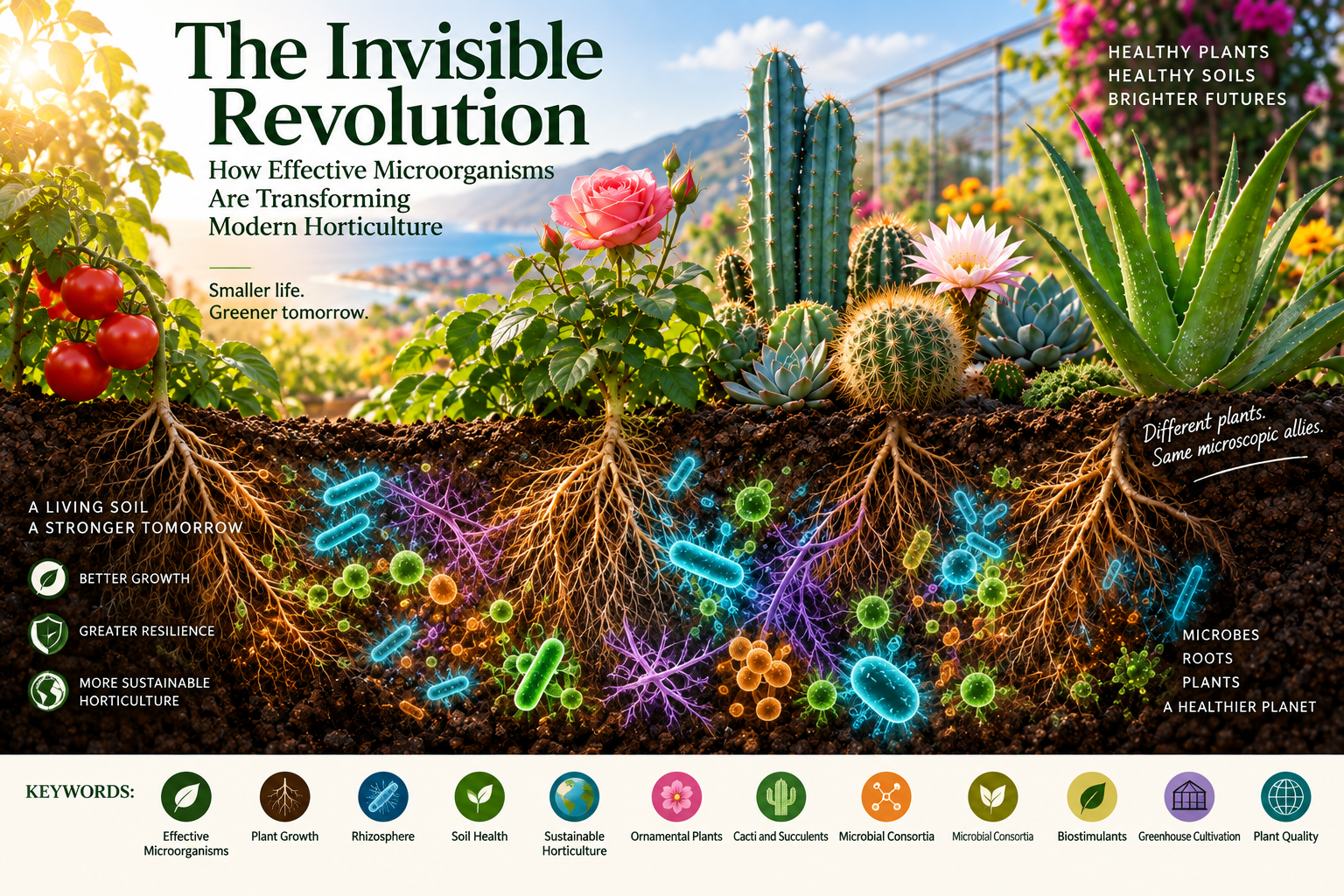
When we admire a flourishing rose, harvest a juicy tomato or marvel at the sculptural beauty of a cactus, we naturally focus on what we can see. Leaves, flowers and fruits capture our attention, while the most important activity often takes place underground. Beneath every healthy plant lies an extraordinary microscopic world inhabited by billions of bacteria, fungi, yeasts and other microorganisms that continuously interact with roots. These invisible organisms form one of the most complex ecosystems on Earth and play a decisive role in plant growth, soil fertility and environmental sustainability. For many years agriculture concentrated mainly on fertilizers, irrigation systems and crop protection products. Although these tools remain fundamental, modern research has revealed that plant productivity depends not only on nutrients and water but also on the biological activity of the soil. A living soil is far more than a physical support: it is an ecosystem where microorganisms recycle nutrients, decompose organic matter, improve soil structure and communicate with plant roots through sophisticated biochemical signals.
Among the biological technologies attracting increasing interest are Effective Microorganisms (EM), microbial communities designed to enhance beneficial biological processes and support healthier, more resilient crops.
What are Effective Microorganisms?
Effective Microorganisms are mixed cultures of naturally occurring beneficial microorganisms that work together rather than individually. Typical formulations include lactic acid bacteria, photosynthetic bacteria, beneficial yeasts and other microbial groups capable of coexisting within the same environment. Unlike fertilizers, EM do not primarily provide nutrients to plants. Unlike pesticides, they are not intended to eliminate pathogens directly. Their purpose is to encourage a biologically active growing environment where beneficial microorganisms become more competitive and ecological processes function more efficiently.
The philosophy behind EM is surprisingly simple: instead of forcing plant growth through increasing external inputs, strengthen the biological system that naturally supports plant development.
This concept reflects a broader change in modern agriculture. Rather than considering soil as an inert substrate, researchers increasingly describe it as a living ecosystem whose biological balance influences productivity, crop quality and resilience.
The rhizosphere: the hidden city around plant roots
The area immediately surrounding plant roots is known as the rhizosphere, one of the busiest biological environments on the planet. Roots continuously release sugars, amino acids, organic acids and numerous other compounds into the surrounding soil. These substances act as food for microorganisms, which respond by carrying out functions that benefit the plant. Some bacteria release nutrients trapped in soil particles. Others produce natural compounds that stimulate root growth. Beneficial fungi extend the effective root system through networks of microscopic filaments capable of exploring much larger volumes of soil than roots alone. Rather than existing independently, plants and microorganisms function as partners. Modern biology increasingly describes plants as holobionts, living systems composed not only of plant tissues but also of the microbial communities associated with them.
The healthier this underground ecosystem becomes, the greater the potential for vigorous plant development.
How Effective Microorganisms support plant growth
The effects of Effective Microorganisms are indirect but potentially wide-ranging. One of their principal contributions is improving biological activity within the substrate or soil. A biologically active substrate generally decomposes organic matter more efficiently, recycles nutrients more effectively and creates favorable conditions for root development. Some microorganisms contained within EM formulations produce enzymes that accelerate the decomposition of organic residues, making nutrients more readily available for plant uptake. Others synthesize natural metabolites that influence plant physiology or contribute to maintaining microbial equilibrium around the roots. Improved root development often represents one of the earliest visible responses. Stronger roots enable plants to explore a greater volume of growing medium, increasing their capacity to absorb both water and nutrients. Under stressful conditions such as temporary drought or limited nutrient availability, this enhanced root system may improve overall plant performance.
It is important to recognize that EM are not a universal solution. Their performance depends on crop species, substrate composition, irrigation management and environmental conditions. They should therefore be regarded as one component of integrated crop management rather than a substitute for sound agronomic practices.
From vegetable production to ornamental horticulture
Interest in Effective Microorganisms has expanded rapidly across many sectors of horticulture. In vegetable production, growers seek healthier soils capable of sustaining repeated cultivation cycles while reducing environmental impacts. Biological soil management has therefore become increasingly attractive, particularly in intensive greenhouse systems where substrates may gradually lose microbial diversity. The ornamental industry presents additional challenges. Unlike food crops, ornamental plants are evaluated primarily according to their aesthetic quality. Compact growth, abundant flowering, healthy foliage and strong root systems determine commercial value. Consequently, technologies capable of improving plant quality without increasing chemical inputs are receiving considerable attention.
Effective Microorganisms fit well within this approach because they aim to improve the biological environment rather than simply supplying additional nutrients.
Cacti and succulents: unexpected beneficiaries
Succulents are often perceived as plants requiring little biological support because they naturally survive under harsh environmental conditions. However, research suggests that even these highly specialized plants can benefit from biologically active growing media. Recent studies carried out by Domenico Prisa and collaborators have explored the application of Effective Microorganisms in several ornamental succulent species cultivated under greenhouse conditions.
Research on Myrtillocactus geometrizans demonstrated that microbial inoculation promoted healthier vegetative development and improved overall plant quality. The results suggested that enriching the microbial activity of the growing substrate may stimulate root performance and support more vigorous growth even in species naturally adapted to arid environments.
Additional investigations involving Echinopsis hybrids evaluated the combined use of Effective Microorganisms and natural chabazite zeolite. This integrated approach combined biological activity with improved physical properties of the substrate, creating conditions favorable for root establishment, water management and nutrient availability. The work highlighted the importance of considering both biological and physical aspects of the growing medium when designing sustainable cultivation systems.
Further studies focused on Aloe barbadensis Miller, where microbial inoculants were evaluated alongside natural biostimulants. The experiments demonstrated how biological technologies can complement one another, supporting plant growth while reducing dependence on conventional agricultural inputs.
These investigations illustrate an important concept: Effective Microorganisms rarely act through a single mechanism. Instead, they influence an entire network of biological interactions involving roots, substrate microorganisms, nutrient cycling and plant physiology.
Beyond EM: the era of microbial consortia
Plant microbiology is evolving rapidly.
While the first generation of biological products often focused on individual microbial groups, current research increasingly investigates microbial consortia, carefully designed communities in which different beneficial microorganisms perform complementary ecological functions. Plant growth-promoting rhizobacteria, mycorrhizal fungi, Effective Microorganisms, phosphate-solubilizing bacteria and numerous other beneficial microbes can interact synergistically. Each contributes different services, including nutrient mobilization, hormone production, disease suppression, improved water uptake and stimulation of root architecture. This systems-based approach reflects a broader understanding of plant biology. Healthy crops do not depend on isolated microorganisms but on balanced microbial ecosystems.
Several of Domenico Prisa’s recent studies on ornamental plants follow precisely this direction, exploring integrated biological systems rather than single microbial inoculants. Such research represents an important step toward designing cultivation strategies that harness the complexity of natural microbial communities instead of relying on isolated biological components.
Sustainability begins below ground
One of the greatest advantages of biological technologies lies in their compatibility with sustainable agriculture. Healthy microbial communities improve soil structure, contribute to organic matter decomposition and promote nutrient recycling. In container production they may help maintain biologically active substrates over multiple cultivation cycles, while in open-field agriculture they complement regenerative practices such as compost application, cover cropping and reduced soil disturbance. The objective is not to eliminate fertilizers or crop protection products entirely but to create production systems that rely more heavily on natural biological processes. This approach aligns with global efforts to reduce environmental impacts while maintaining high crop quality.
As climate change intensifies droughts, heat waves and soil degradation, biological resilience becomes increasingly valuable. Microorganisms may play an essential role in helping crops adapt to these changing conditions.
Looking toward the future
The future of horticulture will likely be shaped by advances in microbiome science. Researchers are now using DNA sequencing and other molecular tools to identify thousands of microorganisms living around plant roots. Artificial intelligence and precision agriculture technologies are beginning to analyze these enormous datasets, helping scientists understand which microbial communities perform best under different environmental conditions.
In the coming years, growers may use tailor-made microbial consortia specifically designed for individual crops, substrates or climatic conditions. Instead of applying the same biological product to every species, future horticulture may rely on customized microbial ecosystems optimized for tomatoes, roses, orchids, succulents or nursery trees.
Such developments represent one of the most exciting frontiers in sustainable agriculture.
Growing plants by growing life
The story of Effective Microorganisms is ultimately a story about rediscovering nature’s own strategies. For hundreds of millions of years, plants have evolved alongside microorganisms, forming partnerships that allowed them to colonize nearly every terrestrial environment. Modern agriculture is beginning to recognize the extraordinary value of these ancient relationships. Rather than viewing soil simply as a medium that holds roots, we increasingly understand it as a living ecosystem whose biological diversity influences plant growth, health and resilience. Effective Microorganisms exemplify this new perspective by focusing not on replacing nature but on supporting its natural processes. Research carried out around the world, including the contributions of Domenico Prisa and collaborators in ornamental horticulture and succulent cultivation, demonstrates how beneficial microbial communities can become valuable allies in modern production systems. Their greatest contribution may not be a single measurable effect, but their ability to restore biological complexity where intensive cultivation has often simplified it.
As horticulture moves toward a future defined by sustainability, climate resilience and environmental responsibility, one lesson becomes increasingly clear: the healthiest plants are often those supported by the healthiest soils. And beneath every thriving crop lies an invisible community working tirelessly, reminding us that some of agriculture’s greatest innovations begin with the smallest forms of life.