


by Damiano Spagnuolo 1,*,Domenico Prisa 2,Anupam Kundu 3,Maria Grazia De Michele 4,Valentino Russo 4 andGiuseppa Genovese 1
1Department of Chemical, Biological, Pharmaceutical and Environmental Sciences, University of Messina, Viale F. Stagno d’Alcontres 31, 98166 Messina, Italy
2Research Centre for Vegetable and Ornamental Crops, Council for Agricultural Research and Analysis of Agricultural Economics, Via Dei Fiori 8, 51012 Pescia, Italy
3Applied Phycology Laboratory, Department of Botany, Visva-Bharati, Santiniketan 731235, India
4Promethea Biochem Solutions S.r.l., Via del Tratturello Tarantino 6, 74123 Taranto, Italy
*
Author to whom correspondence should be addressed.
Phycology 2025, 5(2), 22; https://doi.org/10.3390/phycology5020022 (registering DOI)
Submission received: 30 April 2025 / Revised: 23 May 2025 / Accepted: 27 May 2025 / Published: 3 June 2025
Abstract
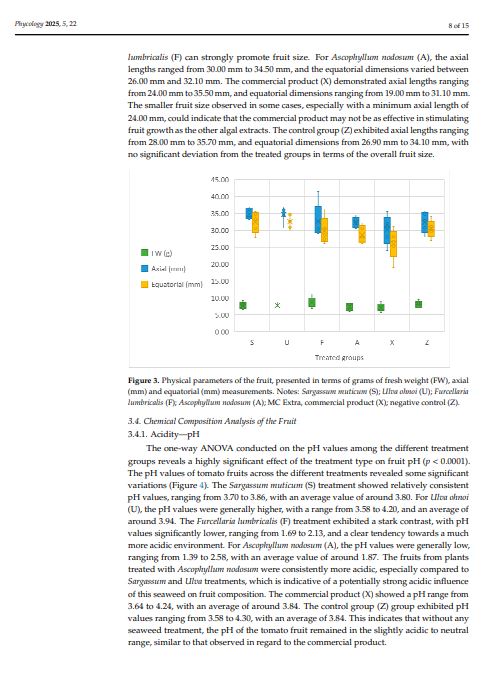
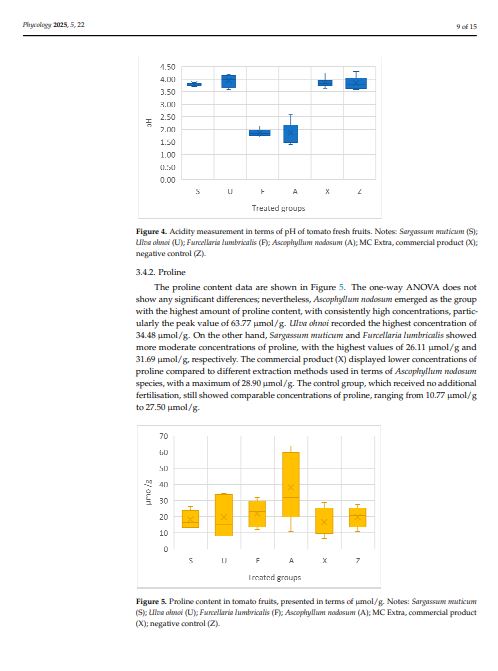
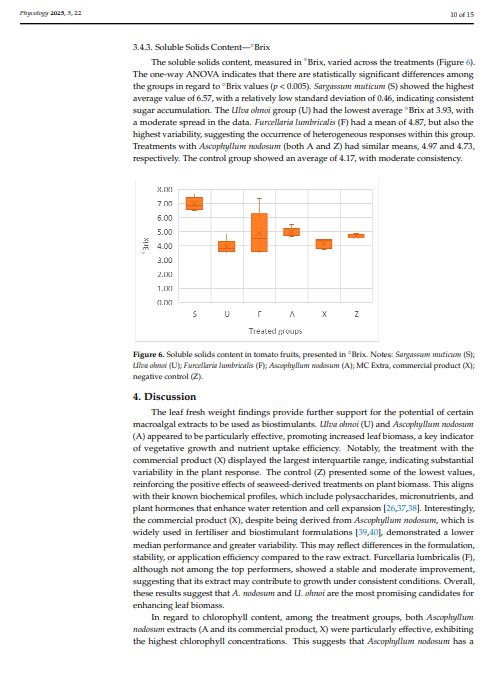
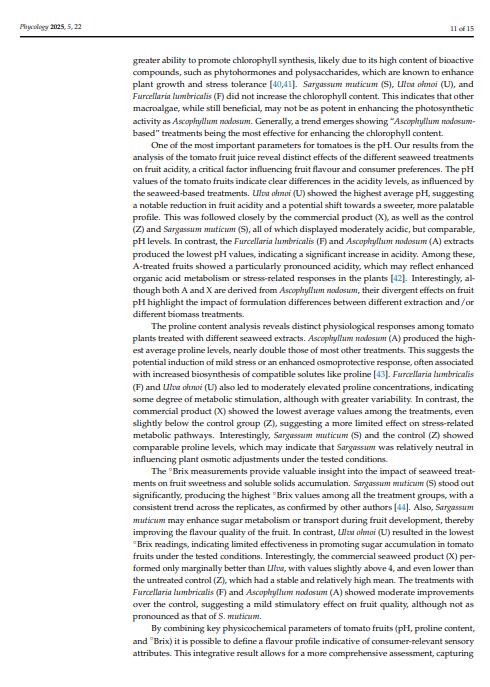
Macroalgal extracts are widely recognised as biostimulants that enhance crop productivity and plant growth under both optimal and stressful conditions. They offer a sustainable approach to mitigating the adverse effects of abiotic stress on crop development. This study investigates the efficacy of macroalgal-based fertilisers in enhancing tomato (Solanum lycopersicum L.) growth, yield, and fruit quality, as sustainable alternatives to chemical fertilisers. Different seaweed species (Sargassum muticum, Ulva ohnoi, Furcellaria lumbricalis, Ascophyllum nodosum, and a commercial A. nodosum extract) were evaluated as foliar treatments. The results showed that while the leaf fresh weight and chlorophyll content were not significantly affected, the fruit morphology and biochemical composition exhibited notable variations. Sargassum muticum-treated fruits displayed the highest °Brix (6.57), indicating superior sugar accumulation, while Ulva ohnoi maintained near-neutral pH levels (avg. 3.94), suggesting balanced acidity. Ascophyllum nodosum extracts induced the highest proline concentrations (peak: 63.77 µmol/g), but also caused extreme acidity (pH 1.39–2.58). Furcellaria lumbricalis enhanced the fruit size (axial length up to 41.4 mm), but reduced the pH sharply (1.69–2.13). The commercial product underperformed in regard to sugar content and flavour complexity. The integrative analysis revealed species-specific flavour profiles: Sargassum yielded sweet, mildly acidic fruits; Ascophyllum produced intensely aromatic, acidic tomatoes; and Ulva resulted in bland flavours. These findings underscore the importance of algal species and extraction methods in tailoring biofertilisers for target fruit qualities. This study advocates for the use of macroalgal fertilisers in sustainable agriculture, but highlights the need for optimised formulations to balance crop yield, taste, and stress adaptation.
Keywords:
biostimulant; soil fertility; biofertiliser plant growth; sustainable agriculture; macroalgal extracts






 TECNICHE INNOVATIVE PER LA COLTIVAZIONE E DIFESA DELLE PIANTE, L'APICOLTURA, LA ZOOTECNIA E IL RISANAMENTO AMBIENTALE