
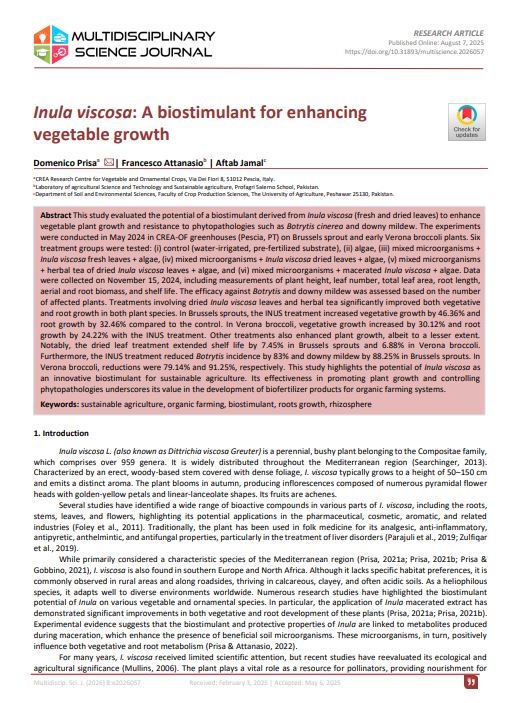
Research Article | Vol. 8 Issue 2 (2026), e2026057 | Published in 07 August 2025
Scopus article
Authors: Prisa, D., Attanasio, F., & Jamal, A. (2025)
- Abstract
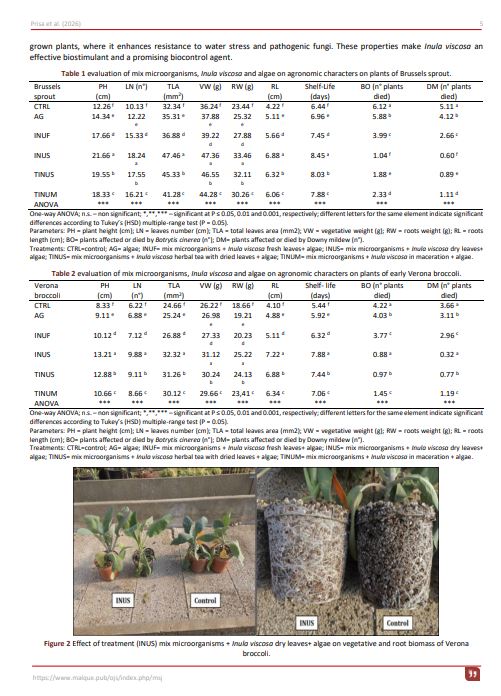
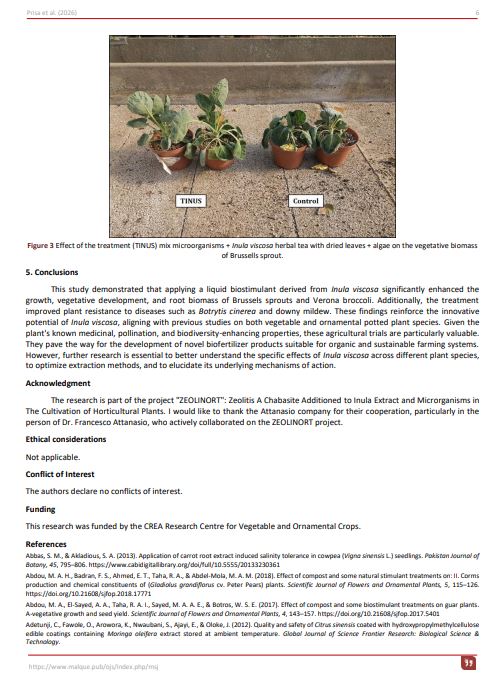
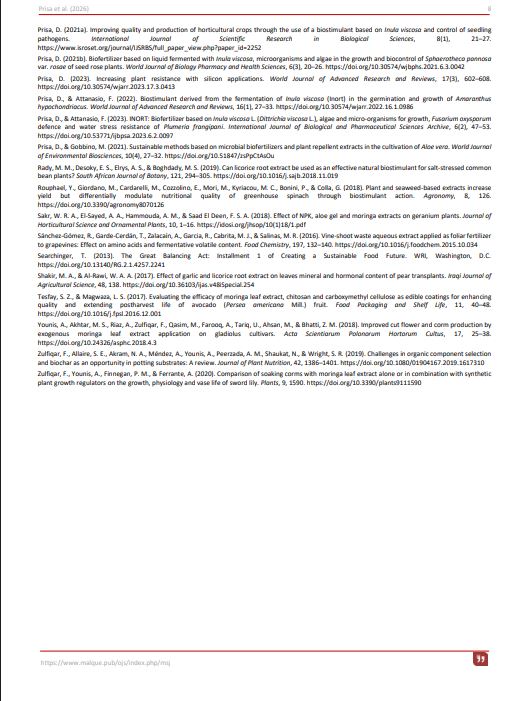
- This study evaluated the potential of a biostimulant derived from Inula viscosa (fresh and dried leaves) to enhance vegetable plant growth and resistance to phytopathologies such as Botrytis cinerea and downy mildew. The experiments were conducted in May 2024 in CREA-OF greenhouses (Pescia, PT) on Brussels sprout and early Verona broccoli plants. Six treatment groups were tested: (i) control (water-irrigated, pre-fertilized substrate), (ii) algae, (iii) mixed microorganisms + Inula viscosa fresh leaves + algae, (iv) mixed microorganisms + Inula viscosa dried leaves + algae, (v) mixed microorganisms + herbal tea of dried Inula viscosa leaves + algae, and (vi) mixed microorganisms + macerated Inula viscosa + algae. Data were collected on November 15, 2024, including measurements of plant height, leaf number, total leaf area, root length, aerial and root biomass, and shelf life. The efficacy against Botrytis and downy mildew was assessed based on the number of affected plants. Treatments involving dried Inula viscosa leaves and herbal tea significantly improved both vegetative and root growth in both plant species. In Brussels sprouts, the INUS treatment increased vegetative growth by 46.36% and root growth by 32.46% compared to the control. In Verona broccoli, vegetative growth increased by 30.12% and root growth by 24.22% with the INUS treatment. Other treatments also enhanced plant growth, albeit to a lesser extent. Notably, the dried leaf treatment extended shelf life by 7.45% in Brussels sprouts and 6.88% in Verona broccoli. Furthermore, the INUS treatment reduced Botrytis incidence by 83% and downy mildew by 88.25% in Brussels sprouts. In Verona broccoli, reductions were 79.14% and 91.25%, respectively. This study highlights the potential of Inula viscosa as an innovative biostimulant for sustainable agriculture. Its effectiveness in promoting plant growth and controlling phytopathologies underscores its value in the development of biofertilizer products for organic farming systems.
Link: https://doi.org/10.31893/multiscience.2026057



Condividi:
- Invia un link a un amico via e-mail (Si apre in una nuova finestra) E-mail
- Condividi su X (Si apre in una nuova finestra) X
- Stampa (Si apre in una nuova finestra) Stampa
- Condividi su WhatsApp (Si apre in una nuova finestra) WhatsApp
- Condividi su Facebook (Si apre in una nuova finestra) Facebook
- Condividi su Telegram (Si apre in una nuova finestra) Telegram
- Condividi su X (Si apre in una nuova finestra) X
- Condividi su Threads (Si apre in una nuova finestra) Threads
- Condividi su LinkedIn (Si apre in una nuova finestra) LinkedIn

 TECNICHE INNOVATIVE PER LA COLTIVAZIONE E DIFESA DELLE PIANTE, L'APICOLTURA, LA ZOOTECNIA E IL RISANAMENTO AMBIENTALE