
Vol. 40 No. 1 (2026): AHS 150 years
Articles
Efficacy of Aloe and Opuntia based composts on growth and phytochemical properties of Salvia officinalis and Rosmarinus officinalis
D. Prisa
CREA Research Centre for Vegetable and Ornamental Crops, Council for Agricultural Research and Economics, Via dei Fiori, 8, 51017 Pescia (PT), Italy.
A. Jamal
Department of Soil and Environmental Sciences, Faculty of Crop Production Sciences, The University of Agriculture, 25130 Peshawar, Pakistan.
DOI: https://doi.org/10.36253/ahsc-18599
Categories
Published 2026-04-07
Keywords
- Biostimulants,
- essential oil composition,
- organic cultivation,
- plant secondary metabolites,
- sustainable agriculture
How to Cite
prisa, domenico, & Jamal, A. (2026). Efficacy of Aloe and Opuntia based composts on growth and phytochemical properties of Salvia officinalis and Rosmarinus officinalis. Advances in Horticultural Science, 40(1), 29–46. https://doi.org/10.36253/ahsc-18599
Copyright (c) 2026 domenico prisa, Aftab Jamal
This work is licensed under a Creative Commons Attribution 4.0 International License.

0

0

Abstract
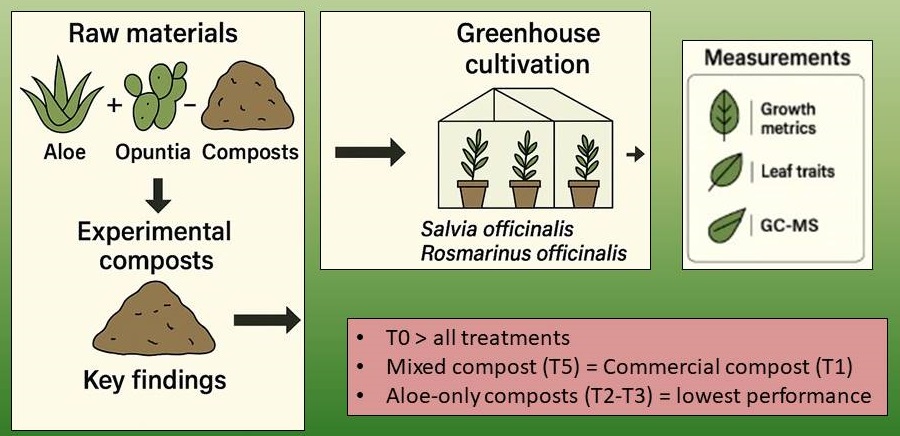
The sustainable cultivation of medicinal and aromatic plants requires alternative substrates that reduce dependence on peat and synthetic fertilisers, while promoting acceptable plant growth and adequate phytochemical quality. This study evaluated the effects of five compost treatments on Salvia officinalis and Rosmarinus officinalis grown in greenhouses at CREA (Pescia, Italy). The treatments examined in this study include use of a peat-based control, commercial compost, monospecific composts derived from Aloe arborescens, Aloe barbadensis and Opuntia ficus-indica, plus a mixed Aloe-Opuntia compost. Growth parameters, photosynthetic performance, chlorophyll content, water and resource use efficiency, microbial biomass and secondary metabolites (phenols, flavonoids, essential oils) for both species were evaluated. For both species tested, the peat-based control supported consistently the best vegetative growth, highest phytochemical levels and was confirmed to be the best for physical support in greenhouse conditions. The mixed Aloe-Opuntia compost functioned similarly to the peat-based control, yet it showed a 5-8% reduction in vegetative growth, however, it still had a higher physiological/metabolic level than other compost based treatments. The results indicate that it is possible to use composts containing a combination of materials with complementary structural and biochemical properties to help overcome some of the limitations of single-species composts. On the other hand, composts made from Aloe vera alone exhibited the weakest agronomic and physiological performances likely due to having a higher electrical conductivity, high rapid decomposition rates, and having a poorly developed substrate structure even though it had a high total nutrient content. There was no difference in the safety of all composts; they caused no negative effects on plant survival, pest infestation, or disease occurrence. Such promising results were recorded particularly for mixed composts, but due to the fact that this was a greenhouse trial, there is a need for further replication to confirm findings. In conclusion, mixed plant composts could be a more sustainable solution, environmentally friendly for producing aromatic plants, and will reduce the reliance on the limited supply of peat.

 TECNICHE INNOVATIVE PER LA COLTIVAZIONE E DIFESA DELLE PIANTE, L'APICOLTURA, LA ZOOTECNIA E IL RISANAMENTO AMBIENTALE