
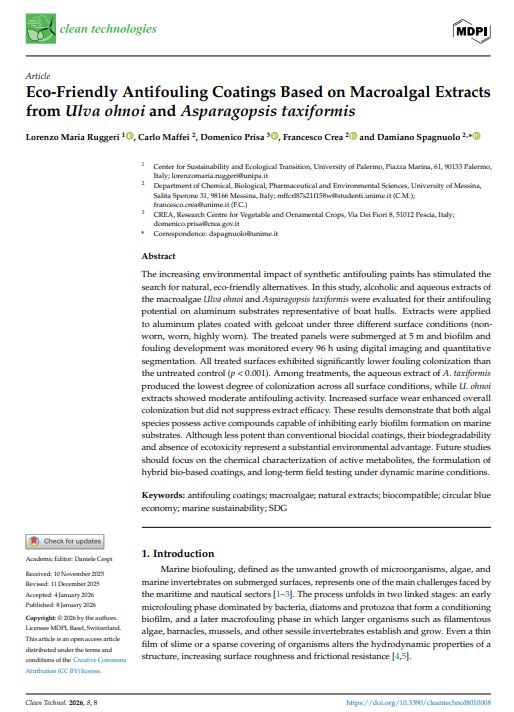
The increasing environmental impact of synthetic antifouling paints has stimulated the search for natural, eco-friendly alternatives. In this study, alcoholic and aqueous extracts of the macroalgae Ulva ohnoi and Asparagopsis taxiformis were evaluated for their antifouling potential on aluminum substrates representative of boat hulls. Extracts were applied to aluminum plates coated with gelcoat under three different surface conditions (non-worn, worn, highly worn). The treated panels were submerged at 5 m and biofilm and fouling development was monitored every 96 h using digital imaging and quantitative segmentation. All treated surfaces exhibited significantly lower fouling colonization than the untreated control (p < 0.001). Among treatments, the aqueous extract of A. taxiformis produced the lowest degree of colonization across all surface conditions, while U. ohnoi extracts showed moderate antifouling activity. Increased surface wear enhanced overall colonization but did not suppress extract efficacy. These results demonstrate that both algal species possess active compounds capable of inhibiting early biofilm formation on marine substrates. Although less potent than conventional biocidal coatings, their biodegradability and absence of ecotoxicity represent a substantial environmental advantage. Future studies should focus on the chemical characterization of active metabolites, the formulation of hybrid bio-based coatings, and long-term field testing under dynamic marine conditions.
Tag: macroalgae
Exploring the Potential of Macroalgae for Sustainable Crop Production in Agriculture

Citation: Prisa, D.; Fresco, R.; Jamal, A.; Saeed, M.F.; Spagnuolo, D. Exploring the Potential of Macroalgaefor Sustainable Crop Production in Agriculture. Life 2024, 14, 1263. https://doi.org/10.3390/life14101263 Link: https://www.mdpi.com/2075-1729/14/10/1263 Abstract: Marine macroalgae, which typically colonize coastal areas, are simple plant organisms. They live on rocks in coastal regions and are classified into red, brown, and green … Continua a leggere Exploring the Potential of Macroalgae for Sustainable Crop Production in Agriculture
 TECNICHE INNOVATIVE PER LA COLTIVAZIONE E DIFESA DELLE PIANTE, L'APICOLTURA, LA ZOOTECNIA E IL RISANAMENTO AMBIENTALE