


*CREA Research Centre for Vegetable and Ornamental Crops, Council for Agricultural Research and Economics, Via dei Fiori 8, 51012 Pescia, PT, Italy.
Research Article International Journal of Science and Research Archive, 2023, 09(02), 630–638.Article DOI: 10.30574/ijsra.2023.9.2.0637DOI url: https://doi.org/10.30574/ijsra.2023.9.2.0637
Received on 25 June 2023; revised on 05 August 2023; accepted on 08 August 2023
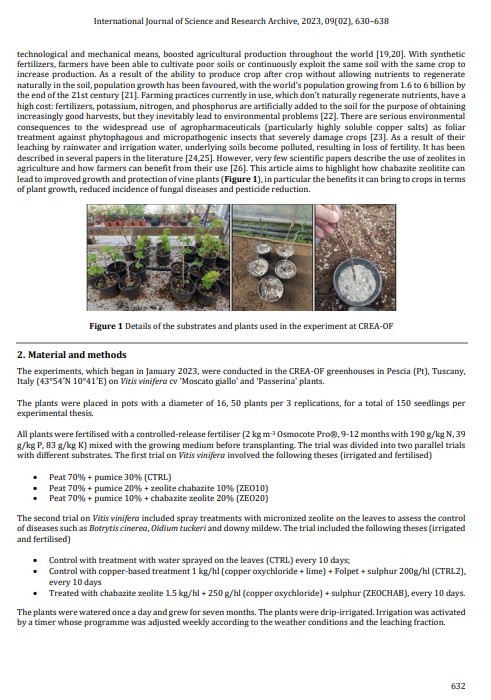
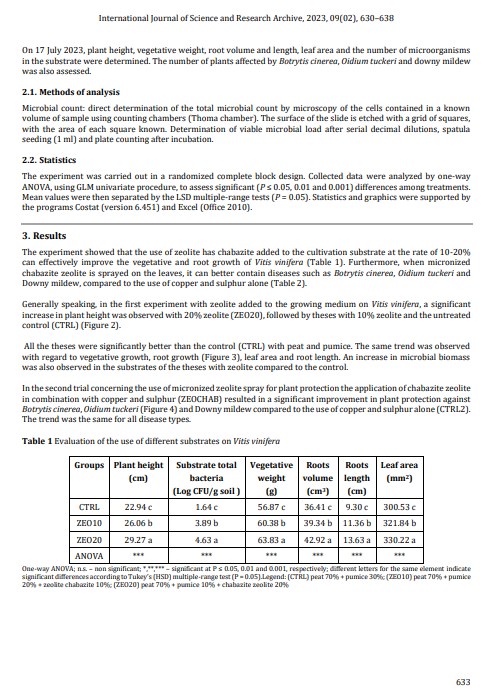
Research objective: This article aims to highlight how chabazite zeolite can lead to improved growth and protection of vine plants, in particular the benefits it can bring to crops in terms of plant development, reduced incidence of fungal diseases and pesticide reduction.Materials and Methods: The experiments, which began in January 2023, were conducted in the CREA-OF greenhouses in Pescia (Pt), Tuscany, Italy (43°54′N 10°41′E) on Vitis vinifera cv ‘Moscato giallo’ and ‘Passerina’ plants. The plants were placed in pots with a diameter of 16, 50 plants per 3 replications, for a total of 150 seedlings per experimental thesis. The first trial on Vitis vinifera involved the following theses (irrigated and fertilized): i) peat 70% + pumice 30%; ii) peat 70% + pumice 20% + zeolite chabazite 10%; iii) peat 70% + pumice 10% + chabazite zeolite 20%. The second trial included spray treatments with micronized zeolite on the leaves to assess the control of diseases such as Botrytis cinerea, Oidium tuckeri and downy mildew. The trial included the following theses (irrigated and fertilized):· Control with treatment with water sprayed on the leaves every 10 days;· Control with copper-based treatment 1 kg/hl (copper oxychloride + lime) + folpet + sulphur 200g/hl, every 10 days;· Treated with chabazite zeolite 1.5 kg/hl + 250 g/hl (copper oxychloride) + sulphur, every 10 days.On 17 July 2023, plant height, vegetative weight, root volume and length, leaf area and the number of microorganisms in the substrate were determined. The number of plants affected by Botrytis cinerea, Oidium tuckeri and downy mildew was also assessed.Results and Discussion: The experiment showed that the use of zeolite has chabazite added to the cultivation substrate at the rate of 10-20% can effectively improve the vegetative and root growth of Vitis vinifera. Furthermore, when micronized chabazite zeolite is sprayed on the leaves, it can better contain diseases such as Botrytis cinerea, Oidium tuckeri and Downy mildew, compared to the use of copper and sulphur alone. According to the researchers, they have extensively researched chemicals that have excellent antifungal activity against a wide variety of fruit and vegetable diseases but can also be safely applied to crops. This has led them to find out that copper-containing zeolites have excellent fungicidal activity while exhibiting no problematic phytotoxicity. Plant pathogenic fungi are controlled by using crystalline zeolite (in particular chabazite), an agricultural and horticultural fungicide.Conclusions: In recent years, rapid population growth and urbanization have limited the agricultural area’s ability to produce more crops. To perform more efficient agricultural activities, higher nutrient application rates are needed and more efficient water irrigation systems must be used. The problem, however, is that a substantial amount of nutrients might be washed out, polluting water resources and reducing product yields if high rates of fertilizers are applied to soils. For this reason, a cost-effective, pervasive, and green solution is essentially required to increase crop yields. Zeolites have been extensively investigated to enhance agricultural productivity.
Alternative substrates; Zeolites; Plant growth; Vitis; Rhizosphere


 TECNICHE INNOVATIVE PER LA COLTIVAZIONE E DIFESA DELLE PIANTE, L'APICOLTURA, LA ZOOTECNIA E IL RISANAMENTO AMBIENTALE
Buongiorno
E’ un piacere contattarla ed inviarle la nostra documentazione riguardante la nostra ZEOFIORE, zeolite campana.
Le racconto in pochissime parole la nostra organizzazione.
La Zeofid S.r.l è un’azienda nata per promuovere e commercializzare Zeolite proveniente dalle ricche terre vulcaniche campane, notoriamente tra i suoli più fertili del nostro pianeta.
La ZEOFIORE possiede un’elevata capacità di immagazzinare elementi e sostanze nutritive, che si traduce in notevoli risparmi in termini di consumi di acqua per l’irrigazione e fertilizzanti.
La nostra ZEOFIORE, infatti, è una zeolite naturale con il contenuto minimo di Chabasite e Philipsite del 68%. In particolare, presenta un alto contenuto di Philipsite (> 30%) raggiungendo un indice di scambio cationico superiore a 2,3 meq/g.
Vi invio in allegato la scheda tecnica e le relative analisi. Saremo ben lieti di organizzare una call con i nostri tecnici per un confronto, non esitate a contattarci.
Cordiali Saluti
Dott. Agr. Carlo Priore
3333090606
"Mi piace""Mi piace"
Buongiorno sono il Dr. Domenico Prisa ricercatore del Crea. Sono colui che diversi anni fa ha sviluppato tutti i protocolli di applicazione e dosaggi della zeolitite. Per collaborazioni o sperimentazione potete contattarmi al 3391062935
"Mi piace""Mi piace"
Buongiorno io sono un ricercatore, studio le zeoliti e sono il primo che ne ha sviluppato i protocolli d’uso in agricoltura circa 25 anni fa
"Mi piace""Mi piace"